
At the Hong Kong Electronics Fair, micro-computing vendor MINIX introduced an ambitious shift in small form factor (SFF) hardware engineering. Moving beyond entry-level desktop replacements, the company unveiled three workstation architectures designed specifically around local AI model weight hosting, high-density memory topologies, and unified heterogeneous computing.
The ER949-AI Ultra: Pushing APU Unified Memory to 192GB
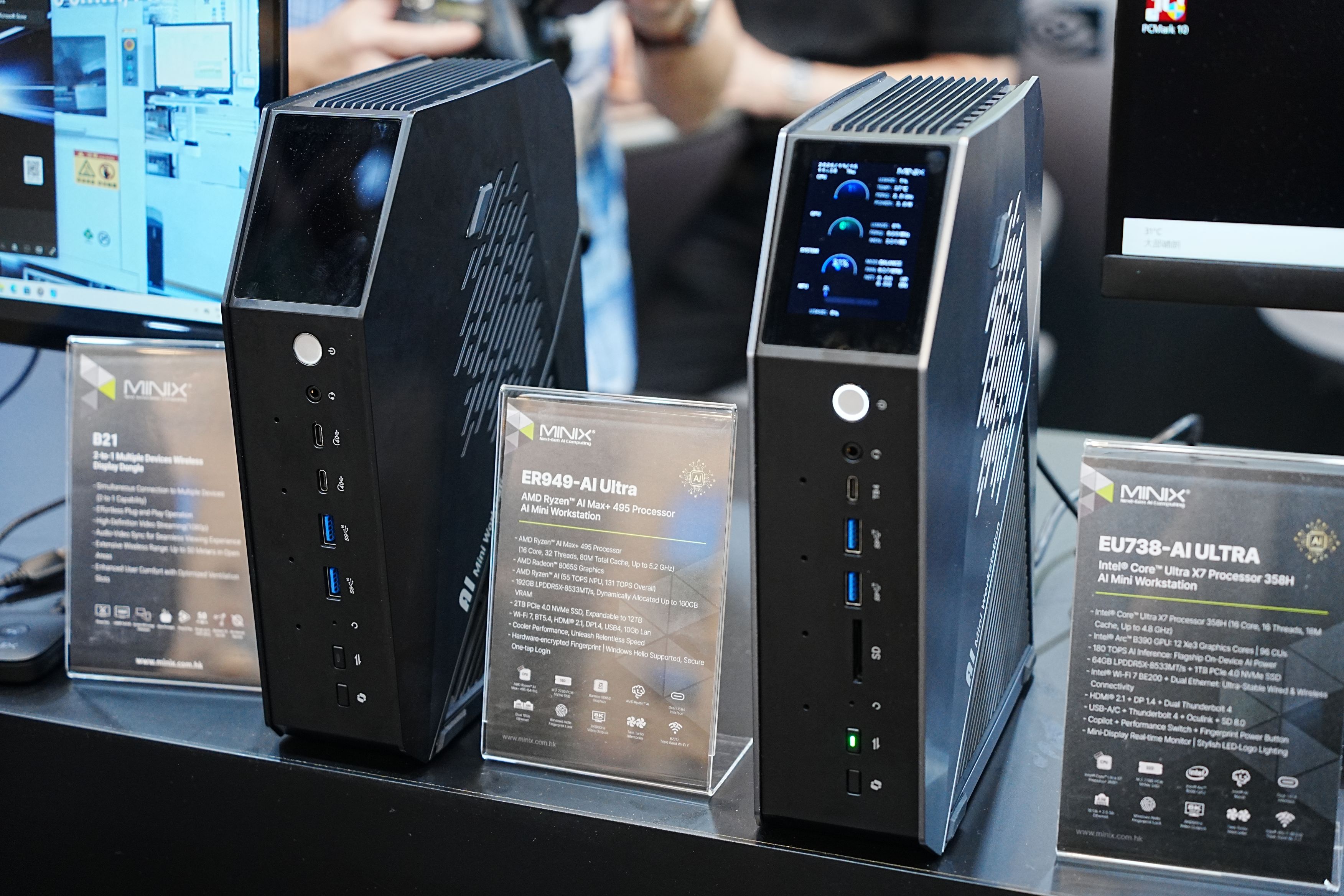
The most technically demanding release in the lineup is the Minix ER949-AI Ultra. Centered on the AMD Ryzen AI Max+ 495 processor—a 16-core, 32-thread architecture boosting up to 5.2 GHz with 80MB of cache—the platform integrates an AMD Radeon 8065S GPU and a dedicated AMD Ryzen AI NPU rated at 55 TOPS, achieving a total platform AI throughput of 131 TOPS.
The defining architectural engineering lies in its memory subsystem:
- Memory Pool: 192GB of soldered LPDDR5X operating at 8533 MT/s.
- Unified Memory Addressing: Allows dynamic allocation of up to 160GB of system memory directly to the GPU as VRAM. This solves the primary bottleneck of local LLM inference—fitting large 70B+ quantized parameter models into fast memory without deploying multi-GPU PCIe clusters.
- Storage and Connectivity: A 2TB PCIe 4.0 NVMe SSD baseline (expandable up to 12TB across onboard slots), 10GbE networking, Wi-Fi 7, Bluetooth 5.4, USB4, HDMI 2.1, DisplayPort 1.4, and a Windows Hello hardware-encrypted fingerprint module.
EU738-AI ULTRA: Client Inference via Intel Arc Xe3 and OCuLink
Targeting x86 developer environments favoring Intel silicon, the Minix EU738-AI ULTRA pairs an Intel Core Ultra X7 358H processor (16 cores, 16 threads, 18MB cache, up to 4.8 GHz) with an integrated Intel Arc 8390 GPU featuring 12 Xe3 graphics cores (96 Compute Units).
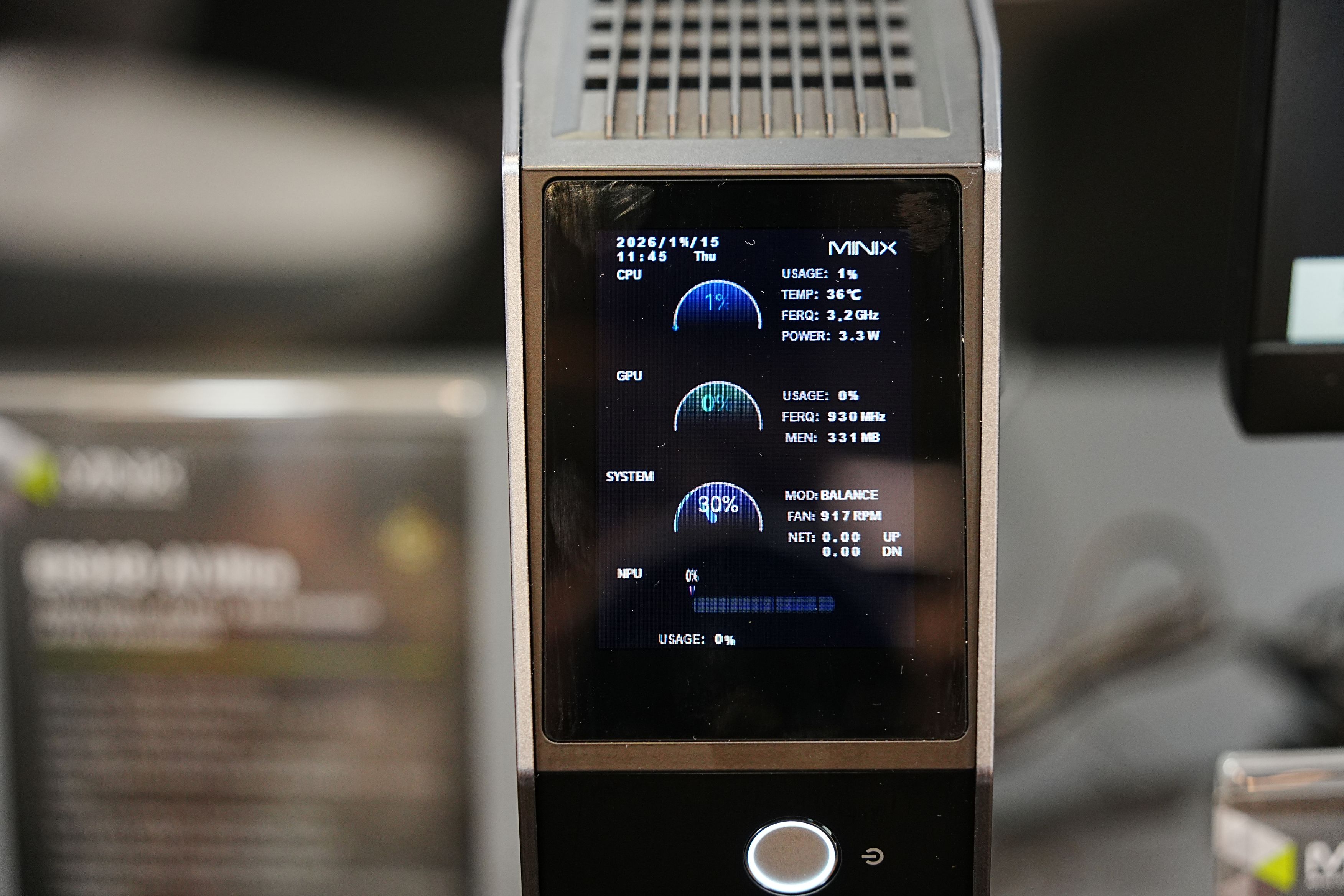
The system yields up to 180 TOPS of aggregate AI inference capability. Built with 64GB of LPDDR5X-8533 MT/s memory and a 1TB PCIe 4.0 NVMe SSD, the chassis incorporates an external OCuLink port alongside dual Thunderbolt 4 channels. The native OCuLink interface provides direct PCIe lane breakout without the protocol translation overhead of USB/Thunderbolt, enabling direct connection to external eGPUs or high-speed data acquisition accelerators. Additional chassis telemetry includes an integrated real-time monitoring display, a physical Performance Switch, and an SD 8.0 high-speed reader.
Minix T4000/T5000: Industrial Generative AI on Jetson AGX Thor
For autonomous systems and enterprise-grade generative AI, the T4000 and T5000 break away from traditional x86 architecture entirely. Built around NVIDIA’s Jetson AGX Thor system-on-module (SoM), the platform integrates:
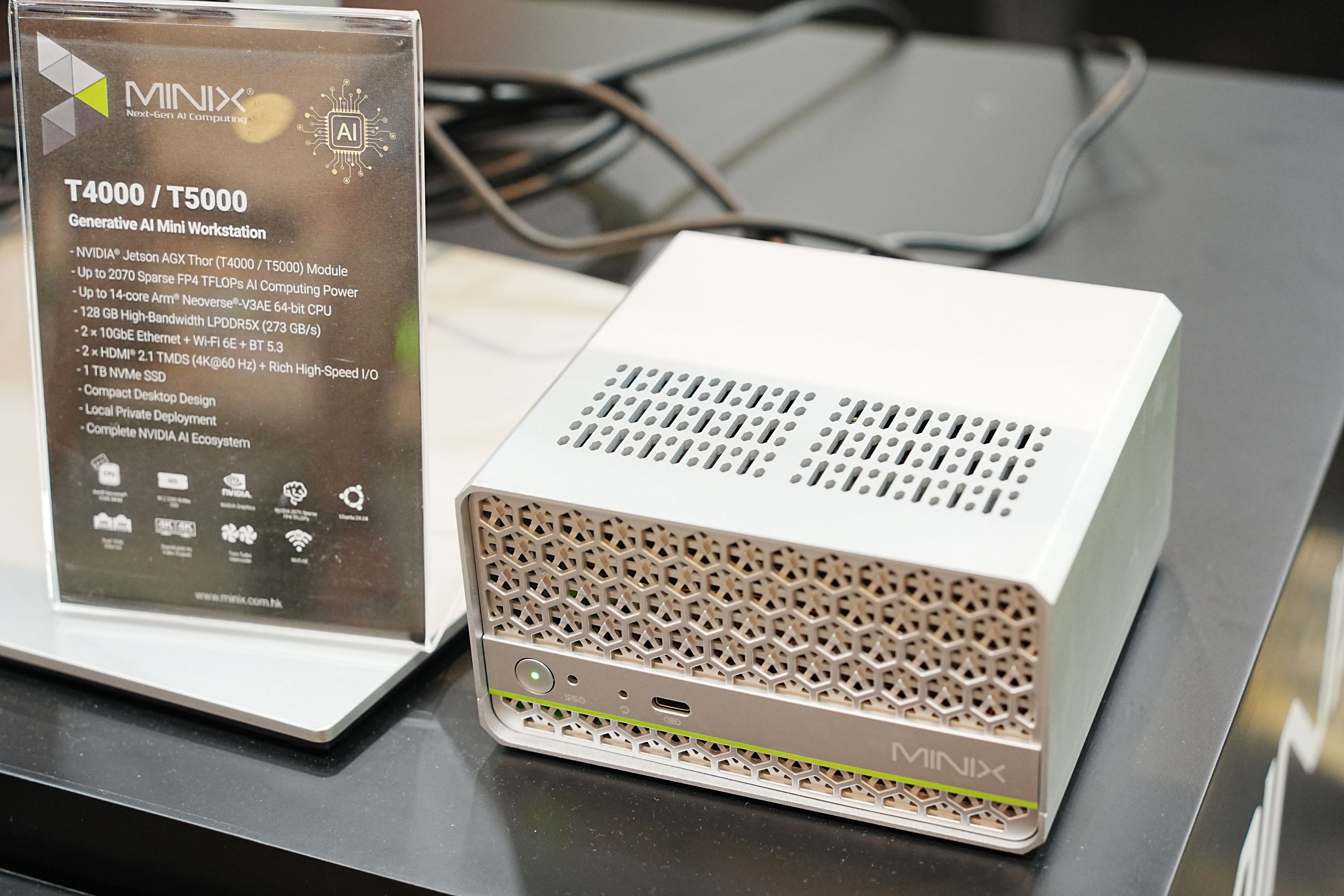
- Up to a 14-core Arm Neoverse-V3AE 64-bit CPU.
- Up to 2070 Sparse FP4 TFLOPs of tensor computing throughput.
- 128GB of LPDDR5X memory delivering 273 GB/s of unified bandwidth.
- Dual 10GbE interfaces, Wi-Fi 6E, and dual HDMI 2.1 outputs.
By leveraging native FP4 precision, the T4000/T5000 allows deployment of multimodal models directly into compact industrial or edge network cabinets, running natively within the full NVIDIA AI software stack.
MINIX’s comprehensive AI product portfolio showcased at the Hong Kong Electronics Fair spans everything from ultrathin mobile productivity to extreme workstation performance, reaffirming the brand’s pioneering leadership in the future of intelligent technology.


Leave a Reply